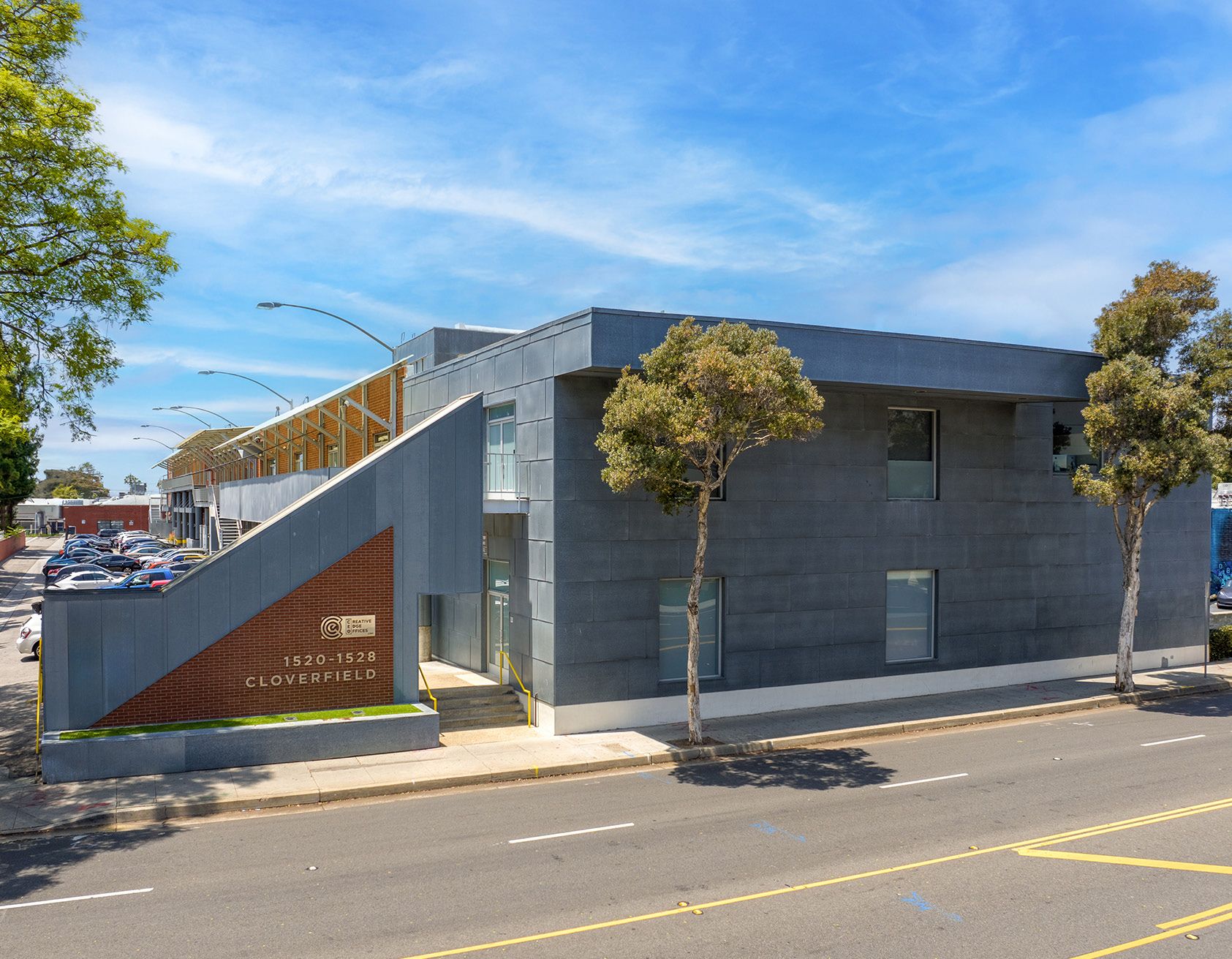
Most people walking down Cloverfield Boulevard have no idea what they're passing. The two-story brick building at 1520–1528 — gray panels, a steel prow, a monument sign reading 1520–1528 CLOVERFIELD — is one of the few buildings Frank Gehry both worked inside and designed, and it has never appeared in his monographs.
A warehouse on the industrial fringe
The masonry building rose in the mid-1960s on what had been a postwar trailer court, in the M-2 industrial fringe that ran alongside Santa Monica's rail corridor. For years it did ordinary warehouse duty. Today the assessor records it at roughly 60,750 square feet — two floors of brick, bow-truss timber ceilings, and clerestory light.
Gehry's studio
By the time he was an established architect, Frank O. Gehry & Associates kept its studio here — the firm's address of record at 1524 Cloverfield, a loft the architect Frederick Fisher remembered as "a giant loft space on Cloverfield… a museum of contemporary art superimposed on an architecture office." The walls carried work by the LA "Cool School" artists Gehry ran with — Irwin, Moses, Bengston, Berlant — while a small team drew at the tables below.
Wrapping the brick in steel
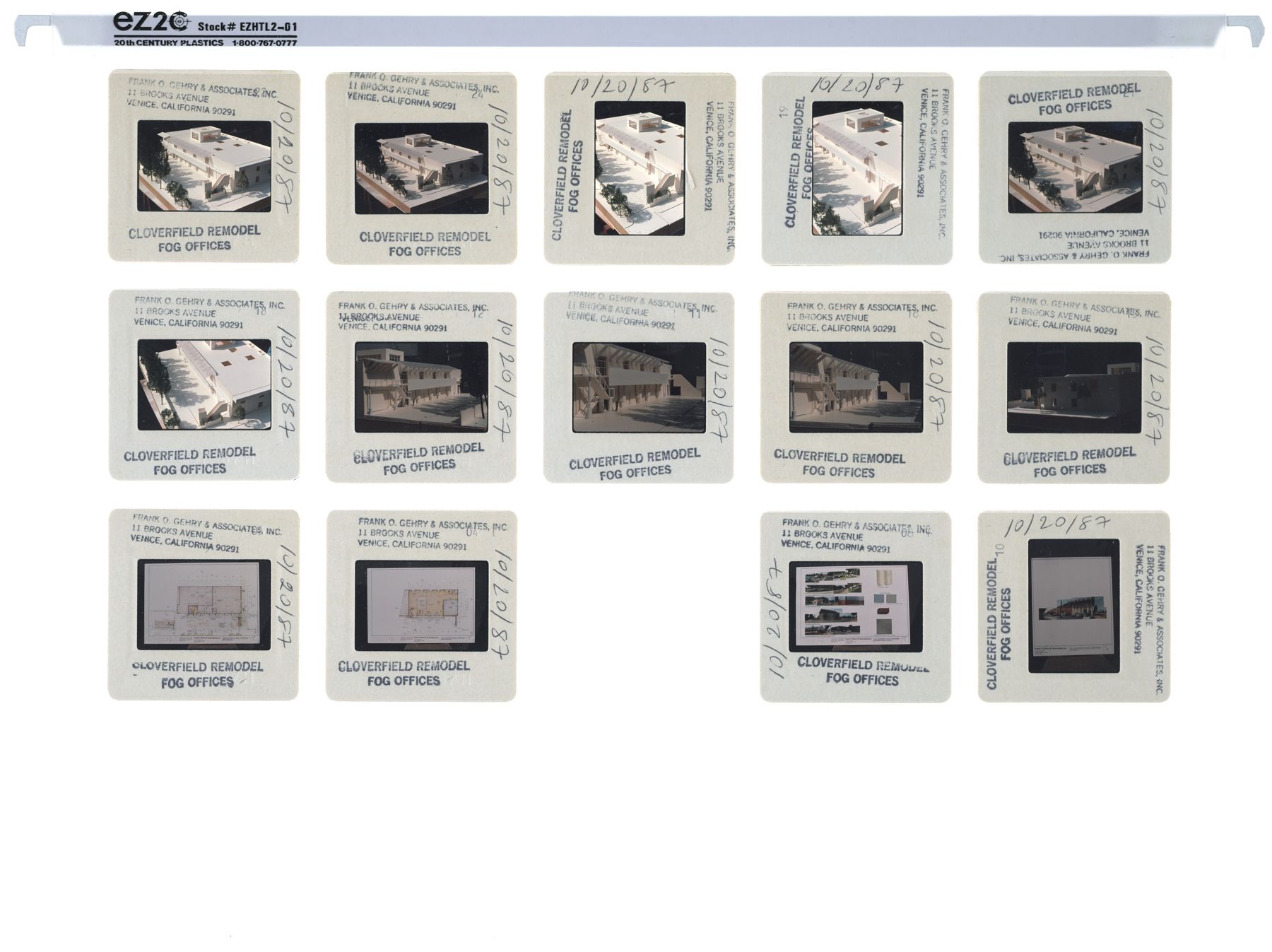
In 1987 Gehry designed the building's own renovation. His office clad the 1965 brick shell in sand-blasted stainless-steel fascia and canopies — a building the architect both occupied and re-skinned. It's the same metal vocabulary that would reappear at the Vitra Design Museum, the titanium of Bilbao, and, in stainless steel, at Walt Disney Concert Hall.
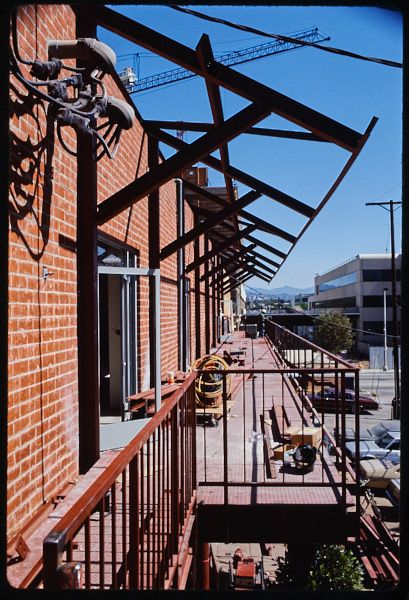
The first design for Walt Disney Concert Hall was drawn inside these walls.
What was drawn here
While the firm worked from Cloverfield, it produced some of the projects that defined late-century American architecture: Loyola Law School, MOCA's Temporary Contemporary, the Chiat/Day "binoculars" building, the Vitra Design Museum, the American Center in Paris, and the 1988 original design for Walt Disney Concert Hall. Gehry won the Pritzker Prize in 1989 while the firm was officed in the building.
The hidden Gehry
Unlike Gehry's celebrated commissions, 1520 Cloverfield sits in no monograph and no works list — a working building rather than a museum piece. Its documentary record lives largely in the Getty Research Institute's Frank Gehry Papers (1954–1988, accession 2017.M.66), which name 1520 Cloverfield directly. It remains one of the only privately held, working Gehry-touched commercial buildings at scale.
A working landmark today
The building still does what it always did — it gets worked in. It's now skylit creative-office space for the producers, post houses, and content studios who make what LA watches, leased by Lee & Associates West LA. Real history, leased to people who care about the room they work in.
Was 1520 Cloverfield really Frank Gehry's studio?
Yes. Frank O. Gehry & Associates kept its studio at the building (address of record 1524 Cloverfield) through the firm's mature era, and Gehry designed the building's 1987 stainless-steel renovation.
What did Frank Gehry design while at 1520 Cloverfield?
Projects drawn during the Cloverfield years include Loyola Law School, MOCA's Temporary Contemporary, Chiat/Day, the Vitra Design Museum, the American Center in Paris, and the first design for Walt Disney Concert Hall (1988). He won the Pritzker Prize in 1989.
Can you lease space at 1520 Cloverfield?
Yes — skylit creative-office lofts are available. Leasing is handled by Lee & Associates West LA, 310.899.2700.